The word tax is deliberate. A tax is a cost attached to participation. In this model, the cost is not a financial deduction from salary. It is the additional cognitive, emotional, behavioural and career effort required to operate in workplace conditions that do not affect everyone in the same way.
The model emerged from the Cost of Black Excellence Research Project, led by Natasha Williams. The current dataset includes 1,153 participants, all of whom consented through the research form or separately by email. The research combines survey findings with open-text accounts to examine how workplace conditions are experienced and how those conditions relate to health, voice, performance, progression and retention.
The three taxes should not be read as separate boxes. They often occur together. That overlap is important because the cost compounds.
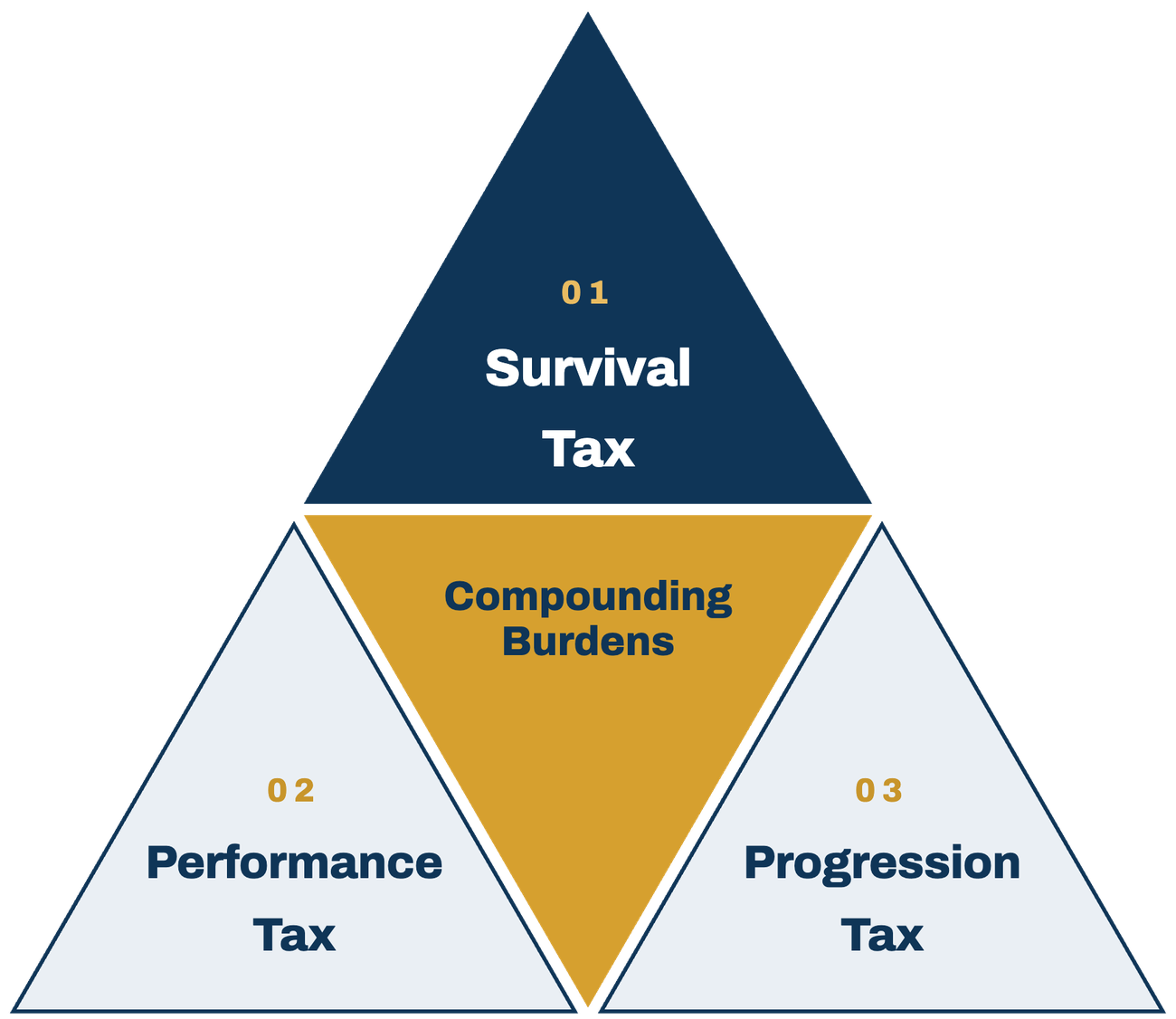
The model shows three connected forms of additional workplace burden. The centre represents the point at which those burdens compound.
Survival Tax is the cost of managing identity, safety and belonging.
Survival Tax describes the effort required to assess whether it is safe to be fully present at work. It includes identity suppression, code-switching, emotional regulation and hypervigilance.
The issue is not whether a professional knows how to behave appropriately in different settings. Everyone makes contextual adjustments. Survival Tax refers to a more persistent form of self-management in which the employee believes that being misread carries unequal consequences.
The COBE research found that 86.9% of participants had toned down aspects of their identity to succeed professionally.
“It sometimes feels like having two versions of yourself: yourself at work and your authentic self.”
Participant, Cost of Black Excellence Research Project
Another participant described the relationship between identity and professional acceptance more directly.
“In the past it meant that I felt like I had to be someone else to succeed. I had to hide parts of me to be respected more.”
Participant, Cost of Black Excellence Research Project
Survival Tax also appears in decisions about voice. Employees may spend time judging whether an opinion is safe to express, whether a challenge will be interpreted as aggression, or whether a workplace issue is serious enough to justify the personal risk of raising it.
This creates organisational consequences. The employee carries the immediate cost, while the organisation loses authenticity, information and trust.
Performance Tax is the cost of proving competence repeatedly.
Performance Tax describes the additional burden created when competence is not fully assumed and therefore has to be demonstrated again and again. It includes proof burden, over-preparation, perfection pressure and working harder to be seen.
Across the current research sample, 86.3% of participants said they always or often felt they needed to work harder than others to be seen as competent.
“Having to constantly show that I am credible at what I do, whereas my white colleagues are taken at face value.”
Participant, Cost of Black Excellence Research Project
One participant described the standard they felt required to maintain.
“Putting 100% into everything I do, not feeling like I have the option to be average, OK or mediocre.”
Participant, Cost of Black Excellence Research Project
The organisational difficulty is that these behaviours often look like commitment. Over-preparation looks like diligence. Taking on more work looks like ambition. Perfectionism looks like high standards. Continual availability looks like dedication.
The hidden question is whether the employee is choosing those behaviours freely or using them to manage the risk of being underestimated.
This distinction matters because the health pattern in the data is substantial. Among participants reporting high proving pressure, 69.8% said their health had been significantly or severely affected, compared with 28.5% among those reporting lower proving pressure.
The survey does not establish causality. It does show that organisations should not treat high output as evidence that the conditions producing it are sustainable.
Progression Tax is the cost of moving forward through unequal friction.
Progression Tax describes the additional effort and uncertainty attached to advancement. It includes slower progression, weak sponsorship, leadership isolation and the burden of having to remain highly visible while lacking access to the informal support that often shapes careers.
Progression is not only about whether someone receives training. It is also about who is advocated for, who receives stretch opportunities, whose potential is recognised, who is invited into influential networks and whose mistakes are treated as part of growth rather than evidence of limited capability.
“It is never an even playing field. Our journey to reach the same rooms is often far more arduous and rarely recognised. We do not always have the same support, sponsorship or backing from senior leadership.”
Participant, Cost of Black Excellence Research Project
“We are constantly working harder to be seen and recognised, while colleagues who do not work as hard get the sponsorship and promotion.”
Participant, Cost of Black Excellence Research Project
Progression Tax changes the meaning of effort. Employees may accept demanding work when they believe it builds a future. The same work starts to feel extractive when responsibility rises but opportunity does not.
This is why progression friction matters for retention. It shapes whether a professional still believes the organisation is a credible place in which to invest their ambition.
The taxes compound rather than simply add together.
The centre of the model represents Compounding Burdens. A professional may be managing identity and safety, proving competence and dealing with progression friction at the same time.
Consider an employee who is highly qualified and performing strongly. They also feel the need to edit how they communicate, prepare more thoroughly than colleagues, remain alert to how mistakes will be interpreted and work harder to gain the same recognition. At the same time, they see weaker performers receiving greater sponsorship and faster progression.
Each burden changes the effect of the others. Progression frustration makes proving pressure harder to justify. Proving pressure reduces recovery. Poor recovery makes vigilance more costly. Weak psychological safety makes it harder to raise the pattern. The employee may keep performing while the overall burden rises.
This is the point at which an individual experience becomes an organisational risk.
The model does not describe a deficit in Black professionals.
The Excellence Tax™ is not a measure of confidence, resilience or capability. It does not ask what is wrong with the employee. It asks what additional burden workplace conditions are producing.
This distinction matters because many organisational responses begin at the individual level. Someone who is exhausted receives resilience support. Someone who is overlooked receives another mentoring programme. Someone who feels unsafe speaking is encouraged to become more confident.
These interventions may have value in the right context. They do not replace examination of the conditions creating the burden.
COBE Intelligence therefore uses the model as a diagnostic lens. The leadership task is to identify where workforce conditions are producing avoidable cost and decide which organisational decisions need to change.
The three taxes connect directly with workforce risk.
Survival Tax affects psychological safety, voice, belonging and trust. Performance Tax affects workload, recovery, error anxiety and the sustainability of high performance. Progression Tax affects sponsorship, leadership pipelines, retention and confidence in career opportunity.
The research findings show why leaders should examine these issues together. 93.0% of participants reported at least one physical or emotional symptom. 64.2% said their health had been significantly or severely affected by workplace or career experiences. 91.3% had considered leaving or had already left a role to protect their wellbeing.
These figures do not mean that every participant experienced the same workplace, the same burden or the same outcome. They show a pattern across a large body of professional experience that warrants deeper organisational diagnosis.
What should leaders do with the model?
The purpose of the Excellence Tax™ Model is not to give organisations three new labels. Its value lies in the questions it prompts.
Leaders should ask where employees are managing identity to feel professionally safe. They should examine whether some groups need more evidence before their competence is trusted. They should compare responsibility with recognition and progression. They should review whether sponsorship is distributed as deliberately as mentoring. They should look at whether high performance is being sustained through overwork, vigilance or reduced recovery.
They should also examine whether employee voice produces visible organisational learning.
These questions move the conversation from individual resilience to workplace conditions.
That is the bridge from research to intelligence.
About the research
The Cost of Black Excellence Research Project is led by Natasha Williams. This article draws on the current dataset of 1,153 participants. All participants consented to take part through the research form or separately by email. Survey findings are descriptive and should not be interpreted as evidence of causality. Participant quotations have been anonymised and, where needed, lightly edited for punctuation or length without changing their meaning.
Read the COBE Intelligence Data & Methodology page for more information about the research and how evidence is interpreted.